ZEMALJSKI FORUM 2025
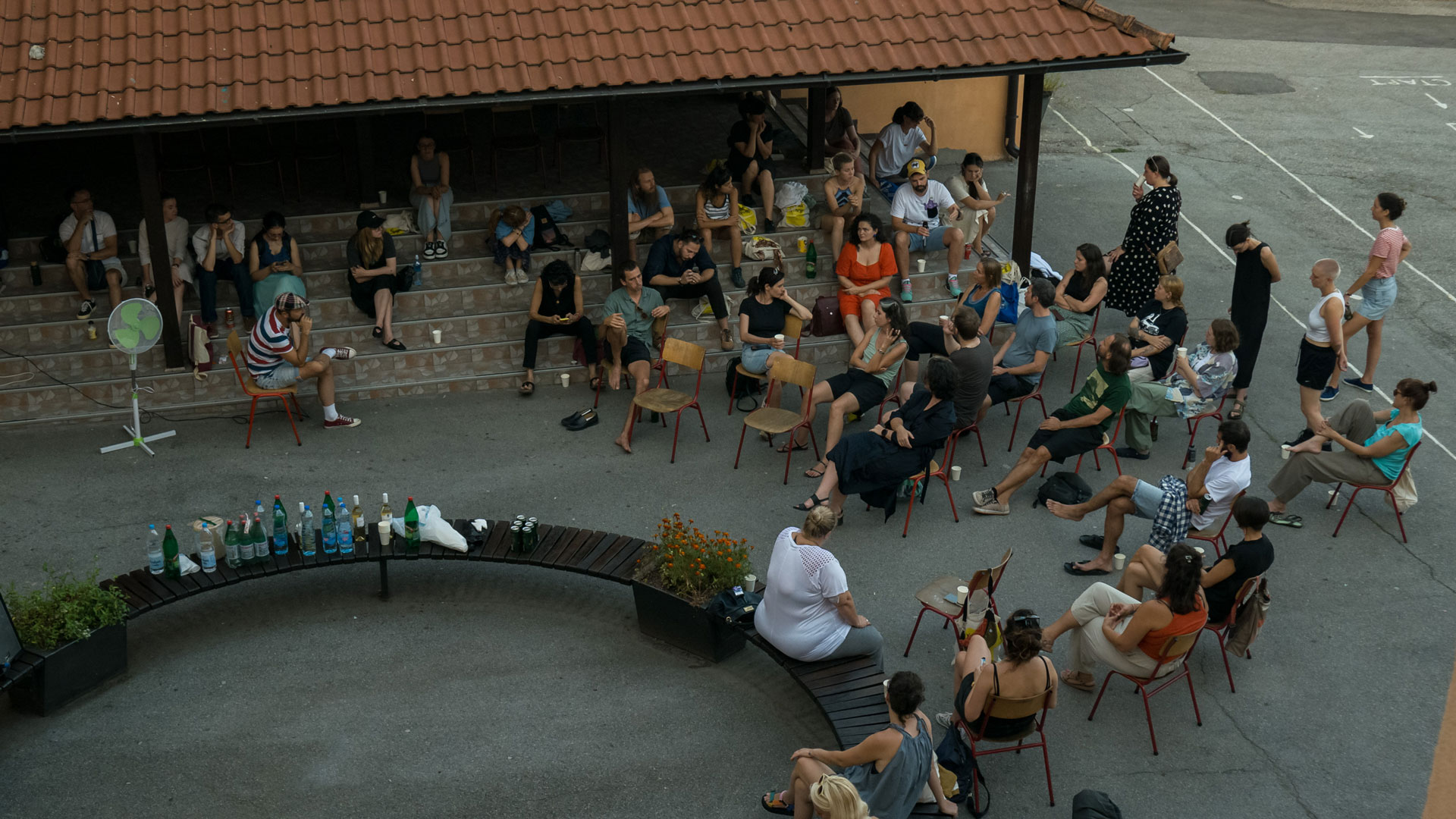
Krajem avgusta 2025. godine organizovali smo treći Zemaljski forum, prvi put u partnerstvu sa još dve drugarske organizacije – SHARE fondacijom i A11 inicijativom. Ove godine smo bili u Vranju, a naše partnerstvo osnaženo i lokalnom inicijativom Generator. Podršku u realizaciji Foruma pružili su nam Heinrich Böll Stiftung, European Fund for the Balkans i Centar za zelene politike.
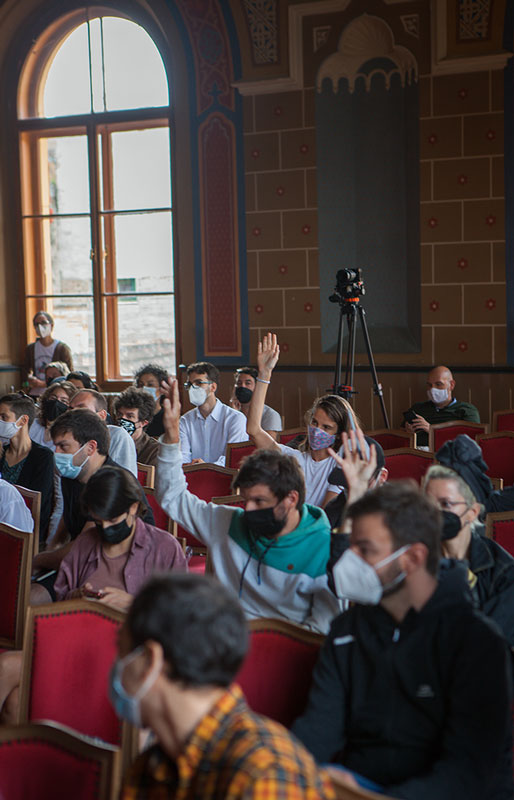
Forum je okupio preko 140 učesnika iz regiona – Mađarske, Slovenije, Hrvatske, Bosne i Hercegovine, Crne Gore, Srbije, Rumunije, a imali smo i goste iz Nemačke i Holandije .
Kroz tri tematska modula, učesnici su istraživali ključna pitanja savremenog društva.
U okviru modula Beyond technophilia and technophobia: Technology and Society, razgovaralo se o tome kako tehnologija oblikuje naše zajednice i političke sisteme – ne kao neutralan alat, već kao sila koja može i da osnaži društvenu promenu i da produbi nejednakosti.
Modul Economy of Exploitation otvorio je pitanja rada, kapitala i eksploatacije – od ekstraktivizma, preko planiranja po meri investitora do zelenih politika i klimatske pravde. Osim što smo bolje razumeli na koji način postojeći ekonomski sistem održava društvene nejednakosti i nepravdne politike, pokušali smo i da zajednički osmišljavamo strategije za sistemsku transformaciju.
Treći modul, Ecosystem of Change, bio je posvećen izgradnji novih savezništava i ekosistema koji mogu podržati dugoročne društvene promene: od grassroots pokreta i političkih inicijativa, do eksperimentalnih modela zajedničkog života i rada.
Popodnevne sesije su pokrile širi opseg tema kroz različite formate, poput praktičnih radionica, šetnji u prirodi, storytelling sesijai diskusija. Osvrnuli smo se i na aktuelne studentske proteste, rat u Gazi, problem nacionalizma i nacionalnih država i mnoga druga goruća politička pitanja.
Tokom pet dana Foruma, Vranje je postalo mesto učenja, samorefleksije, druženja i zajedničkog osmišljavanja strategija za društvenu i prostornu pravdu između celog regiona i lokalne zajednice u Vranju. Za dve godine Forum selimo na neko novo mesto (stay tuned ;)), a Vranju ćemo se rado vraćati nekim drugim povodima


Program

Beyond technofilia and technofobia / technology and society
Trapped Online: Power, Abuse and Exploitation in the Digital Space
Vladan Joler
Day 2// August 25
10.00 – 12.00
Scrolling, shopping online, binge-watching—things we take for granted—rely on hidden systems built on exploited knowledge, labor, and resources. A few tech giants control these processes, making the digital world harder to escape. The AI hype only deepens this cycle, benefiting hyperscalers who own data centers and models. How do we break free from this exploitative system—and is escape even possible?
Demystifying AI: Beyond the Buzzwords and Hype
Bruno Jakić
Day 3// August 26
10.00 – 12.00
AI is changing how we work, live, and make decisions, but it’s not magic. It’s a tool, and its impact depends on who uses it and why. In this talk, Bruno draws on 20 years of hands-on experience to cut through the hype and explain what AI really is, what it can (and can’t) do, and how it’s already shaping society, for good and for bad. Expect a clear, honest look at real-world impacts like job shifts, surveillance, and the strain on democratic systems, plus ideas for how we can respond.
Reclaiming Digital Sovereignty: Strategies for Autonomy in the Digital Age – Strategic Workshop
SHARE Foundation
Day 5// August 28
10.00 – 14.00
In today’s economy, tech giants act as digital feudal lords, owning data and platforms, while users depend on them like modern serfs. Fear of isolation, insecurity, addiction, and pressure for constant productivity keep us tied to these systems. Opting out is a rare privilege. Instead of moving past capitalism, we’re entering tech-driven feudalism. How did we get here—and how do we resist, organize, and build something better?
1001 Ideas for Sustainable and equitable Internet
Fieke Jansen & Niels ten Oever (Critical Infrastrukture Lab)
Day 2// August 25
12.30 – 14.00
Lithium mines in the Andes and e-waste dumps in Ghana seem far from clean data centers—yet one cannot exist without the other. This interactive session explores why climate and environmental impacts must be central to digital rights struggles. We’ll cover raw material extraction, land exploitation, and the extractive tech economy harming climate justice—then brainstorm how all this connects to your digital rights work.
Digital surveillance – metadata, biometrics and spyware
SHARE Foundation
Day 3// August 26
12.30 – 14.00
Digital surveillance is growing fast, embedding itself into daily life—from metadata extraction and spyware to biometric tracking in public spaces. Even without devices, our movements and identities are monitored. This session explores how surveillance erodes privacy and normalizes control. We’ll examine the tools, the myth that privacy is outdated, and the deep impact on human rights, including freedom of expression and dissent.
Punching Down: How Advanced Technologies Affect Marginalized Communities
SHARE Foundation
Day 4// August 27
12.30 – 14.00
Online harassment aims to silence and exclude—especially women and marginalized groups. Tactics like doxxing, cyberstalking, and non-consensual content target those who challenge societal norms. From biased platform design to digital smear campaigns, navigating online spaces is harder for marginalized communities. This session explores how Big Tech and states use digital tools to reinforce existing systems of discrimination.
Ecosystem of Change
Dispatches from Struggle
Šandor Lederer, Ajda Pistotnik , Jovica Lončar, Tihomir Dakić, Filip Jovanovski, Sidorela Vatnikaj, Donika Çapriqi, George Zamfir, Stefan Slavković, Sonja Dragović
Day 2// August 25
10.00 – 14.00
This opening session maps progressive struggles across the region. Activists, professionals, and journalists from ten countries will share insights into key fronts of struggle, modes of organizing, and obstacles they face. The session highlights local issues, regional trends, and geopolitical forces shaping them—setting the stage for deeper discussion on social change and the strategies needed to achieve it.
The crisis of the civil society paradigm
Srđan Đurović
Day 3// August 26
10.00 – 12.00
Faced with a climate crisis, democratic decline, and a digital post-truth era, this workshop questions if traditional activism and civil society models still work—or if new frameworks are needed. Is civil society tired or worse in a crisis? Can it adapt to shifting realities? Together we’ll explore how global trends impact activist identities, strategies, and visions for change—and whether new forms of political imagination are urgently needed across all levels.
A Modest Proposal: Total Sorition
Day 5// August 28
10.00 – 12.00
Representative democracy favors the rich; direct democracy favors those with time. We propose a return to the lottery—the most democratic method of selection. Random selection ensures equal chances for all and prevents permanent hierarchies. Only when everyone has an equal chance does politics become a space for broad social negotiation, rather than the backroom dealings of wealthy interest groups.
Unlearning the system: Practices of autonomy and collective infrastructure
Adél Csűrök & Luca Szöllősi ; Tara Blagojević ; Aleksandra Savanović
Day 3// August 26
12.30 – 14.00
As dominant systems deepen inequality, extract resources, and erode collective life, new forms of institution-making are emerging from below. This session brings together initiatives from Belgrade, Budapest, and the island of Vis that challenge dominant paradigms by reclaiming cultural, spatial, and educational infrastructures. Through practices of occupation, cooperative ownership, and autonomous schooling, these projects show how we can unlearn the systems that have failed us and build structures rooted in solidarity, care, and collective agency.
Pirate Care and the Politics of Withstanding
Valeria Graziano
Day 4// August 27
12.30 – 14.00
This session opens with a brief introduction to the Pirate Care book— a collective effort mapping struggles and autonomous organising around care across geographies. Rather than a finished model, the book is a prompt to reflect on building care infrastructures in hostile environments. After this provocation, a facilitated conversation will explore tactics, tensions, and practices of commoning care. Together, we’ll rethink mutiny as a generative force and ask what it means to federate in today’s fragmented landscape.
Dead Ends, Loose Ends, Open Ends
Ilir Gashi
Day 6// August 28
12.30 – 14.00
Dead Ends, Loose Ends, Open Ends is a closing conversation about unfinished work—not just in this module, but in broader struggles for social and political change. In the face of crisis and exhausted paradigms, we ask: What no longer serves us? Where are we stuck—structurally, ideologically, emotionally? And what ideas here might point to new futures? This session doesn’t seek closure or consensus, but makes space for ambiguity, contradiction, and the open ends that invite us to begin again, differently.
Economy of Exploitation
From the ground up: embodied exploration of extraction and liberation
Sofija Stefanović
Day 2// August 25
10.00 – 12.00
In this workshop, we’ll ground ourselves—in our bodies, in place (outdoors), and in the present moment—to explore extraction and liberation through movement, listening, and writing. Drawing on dance improvisation, organizing, and theory, we’ll let ideas emerge from embodied experience. No prior experience is expected. This is an invitation to connect personal transformation with collective liberation from extractive logics—and to carry these practices into the rest of the module and beyond.
Just Because It’s in the Plan Doesn’t Make It Just: How Spatial Planning Enables Extraction for Private Gain
Sonja Dragović
Day 3// August 26
10.00 – 12.00
This session examines how planning regulations enable the extraction of public space for private gain. Using cases from Montenegro, Croatia, and beyond, we show how planning tools—framed as development—legitimize dispossession and enclose commons. Through spatial plans and legal frameworks, we trace how spatial injustice is structured and normalized. We’ll also reflect on the limits and potentials of local resistance, situated knowledge, and reimagining planning beyond extractivism.
Labour, dependency and resource exploitation
Tanja Potežica
Day 5// August 28
10.00 – 12.00
This session explores labour’s role in infrastructures of dependency and resource exploitation. We’ll examine tensions between labour and ecological movements within a work-based society, where interests often diverge—yet both face exploitation. Can shared goals lead to cross-sector alliances? Through examples and discussion, we’ll explore how to move beyond political divisions and imagine forms of resistance that unite labour and ecological struggles in the fight for just transformation.
“New” primitivism – why extractivism is nothing new, but why it seems more important than ever?
Darko Vesić
Day 2// August 25
12.30 – 14.00
Global capitalism is undergoing major shifts as its growth model nears exhaustion. The “green transition” is central to this transformation, driven by the urgency to decarbonize. Yet the technologies behind it demand vast natural resources, raising doubts about its true aims. Profit still relies on extracting nature below its real costs. Unless radically reimagined, this transition risks repeating old injustices rooted in extractivism and the logic of endless accumulation.
Cities Under Siege: Resisting Extractive Urban Development
Božena Stojić, Jovana Božović, Zsuzsi Posfai, Tea Truta
Day 3// August 26
12.30 – 14.00
Extraction is often justified by promises of growth and jobs—whether through mining or urban renewal. In reality, it brings resource loss, displacement, environmental harm, and rising inequality – quite a price for economic growth! Across the region, cities face large-scale investments backed by deregulation, privatization, and corruption. These transnational trends complicate efforts to resist. This panel gathers urban activists from four countries to explore structural drivers of extractive urbanism and strategies for confronting them.
The Other Side of Green: Biodiversity and Climate Politics
Žaklina Živković, Tihomir Dakić, Nemanja Milović
Day 4// August 27
12.30 – 14.00
Climate action is urgent, and decarbonization goals are reshaping Europe’s policies and funding. But as climate agendas grow, so do concerns about what gets prioritized—and what’s left out. Energy transition investments often overshadow struggles for biodiversity, clean water, and justice. This panel brings together Balkan activists and experts to explore tensions between climate and environmental politics, and how to shape a low-carbon transition that is also socially and ecologically just.
Non-extractive horizon of change
Predrag Momčilović
Day 5// August 28
12.30 – 14.00
Predicting the future from today’s crises often leads to dystopia or nostalgia. This session invites participants to explore nonlinear, non-dichotomous pathways beyond extractivism. Using backcasting, we’ll start from a desired future and work backward to identify actions and policies that connect it to the present. Instead of being bound by current limits, we’ll center hope, imagination, and collective visioning to rethink how we live, plan, and relate to nature and each other.
AFTERNOON SESSIONS
Corruption: Brief History of a Contested Term
Mislav Žitko
Day 2// August 25
17.00 – 19.00
At present the notion of corruption is the focal point in contemporary political affairs. It has saturated the discourse of political parties and the imagination of the public. In this session we take a closer look at the history of the notion and changes of its meaning over time, as well as the implications for contemporary political life. Regarding the latter, we will survey the interpretations that see corruption as the key valence issues that gave rise to valence populism and the rise of neither-left-nor-right political programs.
Beyond ‘national interest’: for another ethics of resistance
Aleksandra Savanović
Day 3// August 26
17.00 – 19.00
Nation-states dominate global governance, seen as natural forms of modern life. While a nation conceives of itself either as civic or ethnic, the two are deeply entwined. Today’s surge in “patriotism”—especially in the West—reveals that civic nationalism also relies on exclusionary myths, often laced with racism, misogyny, and supremacy. If patriotism means aligning with a state’s proclaimed “national interest,” we must ask: in a world facing nuclear war and genocide, is that still a horizon worth holding?
Financing of the people, for the people, by the people: Self-contributions and development policy in Yugoslavia and after
Boriša Mraović
Day 4// August 27
17.00 – 19.00
Any credible progressive program for coming socio-environmental crises must address finance, money, and banking. This session revisits a unique fiscal tool from socialist Yugoslavia: self-contributions—democratic mechanisms for pooling money into public investments and infrastructure. Far from a relic, they offer a valuable model for future systems where finance serves public wealth, meets common needs, and operates under democratic control, not market imperatives.
Armed Diplomacy and Complicity: Serbia, Israel, and the Legacy of Yugoslavia
Saša Dragojlo
Day 2// August 25
17.00 – 19.00
Violence is one of the key elements of statehood, and diplomacy based on arms trade – and thus on securing and expanding spheres of sovereignty – is highly effective, as it turns a trade partner not only into an ally but also into an accomplice. How have the relations between Israel and Serbia/Yugoslavia developed – and what role has the arms trade played in that? How was Israel forged, whose weapons fueled the war in Bosnia, and what have Israeli military planes been persistently seeking at Belgrade’s “Nikola Tesla” airport over the past two years?
Digital Counter-Surveillance Workshop
Filip Milošević & Bojan Perkov
Day 3// August 26
17.00 – 19.00
This workshop will recap means of private and state surveillance, further deconstruct targeted and mass surveillance, and provide useful tools and practices to counter them. More specifically, as most of us already have ideas about encrypting communication and data, we will dive deeper into workflows that will demystify and ease the adoption of various tools to mask our identifiers and identities online.
Urban Planning as the Main Battlefield: Resisting Capture, Reclaiming Space
Olga Andrić, Jana Bačeva Andreevska, Martin Vilager Sluga
Day 4// August 27
17.00 – 19.00
As cities across the region are increasingly shaped by private interests and speculative development, urban planning has become a key site of struggle. This session brings together practitioners and activists from Skopje, Belgrade, and Ljubljana who work with communities to resist displacement, defend public space, and co-create urban alternatives. Through grassroots organizing, participatory planning, and institutional engagement, they challenge top-down decision-making and open space for collective urban futures. Together, we’ll reflect on how to resist the capture of the city and how planning can become a tool of solidarity rather than exclusion.
Makerspace: “We can make a bench”
Aleksandar Popović
Day 2// August 25
17.00 – 19.00
Violence is one of the key elements of statehood, and diplomacy based on arms trade – and thus on securing and expanding spheres of sovereignty – is highly effective, as it turns a trade partner not only into an ally but also into an accomplice. How have the relations between Israel and Serbia/Yugoslavia developed – and what role has the arms trade played in that? How was Israel forged, whose weapons fueled the war in Bosnia, and what have Israeli military planes been persistently seeking at Belgrade’s “Nikola Tesla” airport over the past two years?
Is There Such Thing as Just Digitalization? Public Sector Digitalization and its
Impact on Marginalized Communities
Ana Toskić Cvetinović
Day 3// August 26
17.00 – 19.00
During this session, we will discuss the ways how the growing trend of digitalizationof public services affects their delivery and excludes different communities andindividuals, with the specific focus on most marginalized communities and the socialwelfare sector. What are social, legal and other implications of the use of such digitaltools and how to beat the idea to digitalize everything? Come and join us to discussthese issues. By the end of the session, we might even start building out own DigitalLuddites community!
Participatory Theatre: Why we need the trees, we have a discotheque !
Miodrag Kuč
Day 4// August 27
17.00 – 19.00
The workshop deals with the problem of cutting down healthy trees and repurposing part of the public park and cultural institution for the needs of local discotheques. Bearing in mind the drastic increase in temperature in cities, the privatisation of public areas and the lack of space for young people in Vranje, we will try to build unexpected development scenarios and reimagine public policies. By using the forum theatre as a tool for engagement, workshops empower local actors in exploring solutions for diverse oppressions.
If Buildings Could Talk: Тhe cinema in the railway residential building, an invisible public space
Filip Jovanovski
Day 2// August 25
17.00 – 19.00
Erasing traces of collectivity, solidarity, and responsibility from local history fuels neoliberalism, privatizing and stratifying social relations. In Skopje’s post-WWII Railway Residential Building—once with its own yard, laundries, and cinema—the question remains: How can we live better together? Since 2015, If Buildings Could Talk by FR~U has used it as a performative space, blending arts to foster care, solidarity, and civic action, while reimagining the public realm in post-socialist cities.
Is Can storytelling / storylistening help reduce social polarization and strengthen our communities? Tales of a hitchhiker
Ilir Gashi
Day 3// August 26
17.00 – 19.00
Over the past decade, I hitchhiked across the Balkans, Europe, and the Caucasus, meeting people with vastly different—and often opposing—views. On a long ride, conversation continues despite differences, and by journey’s end, perspectives may shift on both sides. In this talk, I share hitchhiking stories that show how dialogue and storytelling can bridge divides, challenge prejudice, deepen listening, and transform the way we see ourselves and others.
Public Health Data as a Tool for Environmental and Social Justice
Aleksandar Stevanović
Day 4// August 27
17.00 – 19.00
Public health data is more than research—it’s a tool for justice. This workshop is for activists and changemakers confronting environmental and social injustice with evidence-based health arguments. We’ll explore how social and commercial determinants shape communities, and develop skills to use data to raise awareness, influence policy, and drive action. Who controls the narrative? Whose health counts? Justice depends on facts—and facts need a voice.
Pop-up Cities and Ecovillages as Pathways to Network States and Bioregional Governance
Day 4// August 27
17.00 – 19.00
The first pop-up city took place in 2023 in Montenegro’s Lustica Bay, led by crypto and longevity communities testing nomadic gatherings, thematic co-work, and alternatives to nation-states. As the Global Ecovillage Network marks 30 years and explores a Balkans+Hungary subnetwork, we’ll discuss the potential and challenges of bridging high-tech global ventures with local grassroots ecological movements—and how such experiments could shape territories, cultures, and policies locally and globally.
CLOSING SESSION
1+1=3
Ana Pinter
Day 5// August 28
17.00 – 19.00
The final session is a feedback session, dedicated to recapping the concepts, ideas, dilemmas, emerging questions, and unresolved curiosities that surfaced before and during the Forum. Using sociometric techniques, participants will engage their bodies, minds, and hearts to reflect and speculate —individually and collectively — on how we might improve our circumstances and strengthen our resistance to dominant, unjust narratives and practices. Together, we will explore possible ways to face the obstacles, setbacks, and barriers that hinder the shift in perspectives necessary for more just and equitable forms of co-living and collaboration.
POVEZANI TEKSTOVI
Njeno pravo na grad
Različit uticaj prostornih politika na žene, poput distribucije stambene funkcije i objekata socijalne infras…
Ekonomija grada
U 2023. godini smo napravili seminar Ekonomija grada, koji je bio otvoren za sve, sa željom da za…
Zemaljski forum
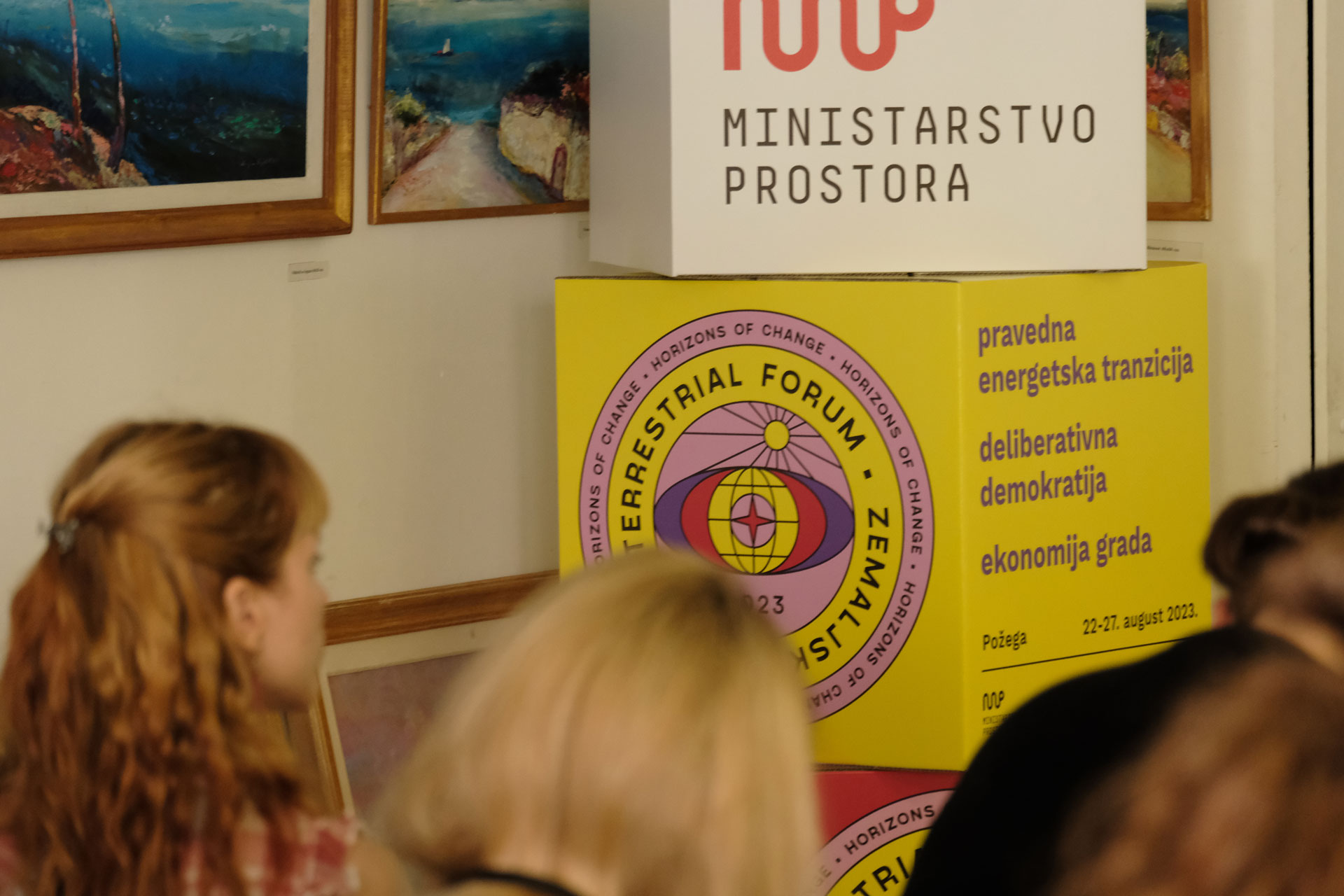
Zemaljski forum je bianualni program koji smo pokrenuli 2021. godine i zamišljen je kao program…
Zemaljski forum 2023
Krajem avgusta 2023. godine organizovali smo drugi Zemaljski forum, pod nazivom Terrestrial …
Zemaljski forum 2021
ZEMALJSKI FORUM 2021Godine 2021. pokrenuli smo bianualni program edukacije i...

Ka drugačijem gradu
Ka drugačijem gradu je javni program kolektiva Ministarstvo prostora koji obuhvata različite …